
Your Heel Takes 1.5 Million Pounds a Day Before You Run a Single Mile.
Your plantar fascia takes 1.2 to 1.7 times your bodyweight with every step.
Up to 7 times when you run.
Let's say you're a guy, 180 pounds, taking 7,000 steps a day.
That's over a million and a half pounds landing on your heel.
Before a single mile.
Here's the part nobody explains.
Your fascia only absorbs that force correctly when your ankle lands in proper alignment.
The moment it drifts, even slightly, even in a way you can't feel, the fascia absorbs force from a sideways angle it was never built for.
The micro-tears concentrate right at the heel bone.
And here's what makes it worse.
Around 40, the ligaments holding your ankle in place start losing their strength.
Not enough to notice on a walk.
Enough that under the impact of running, your ankle drifts on every single stride.
You weren't failing to recover.
You were being torn by a force nobody told you to address.

Comprez™ Dual-Lock Technology Stops the Drift Before It Tears Your Fascia
To break the cycle, the ankle has to stop drifting.
Not just on runs.
Every step to the bathroom, every flight of stairs, every hour on your feet at work.
The drift is happening all day, and so is the tearing.
That's why rest alone never works.
You stop running, but the rotational load on the fascia continues through every step.
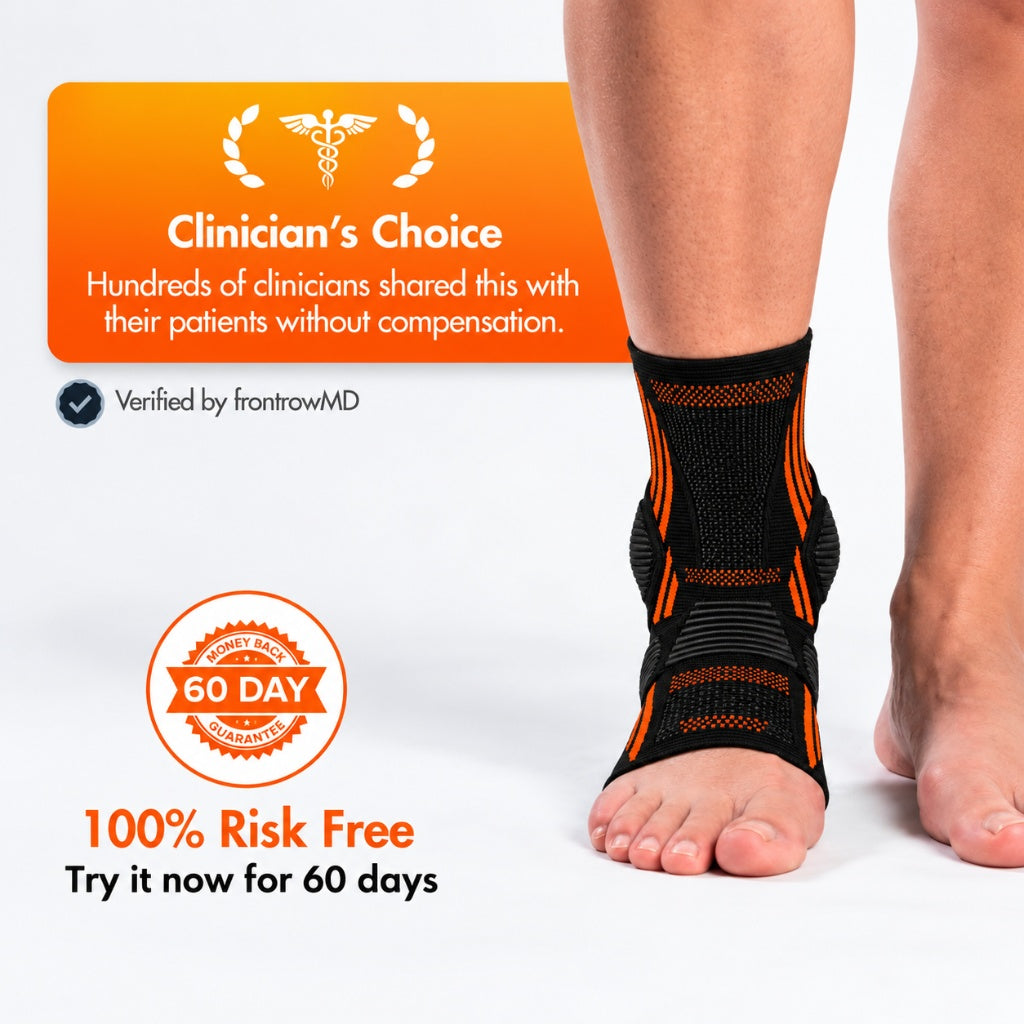
The Comprez™ brace has dual silicone stabilizers positioned on both sides of the ankle joint.
On every footstrike, they physically hold the ankle in neutral alignment.
Then the fabric is engineered to be tightest where overpronation originates, stopping the ankle from drifting before the stabilizers even kick in.
No shifting. No slipping. No rotation getting through.
A generic sleeve might feel supportive standing still. This holds your alignment while you're actually moving and under load.
So every step loads the fascia the way it was designed to be loaded.
The drift stops. The tearing stops. The tissue finally heals.
The Advice That Fixed His PF Won't Fix Yours
Let's be honest about what you've probably spent so far.
- New shoes: $150+.
- Custom orthotics: $300-$500.
- PT copays, week after week.
- And that night splint collecting dust next to your bed.
Same protocol the guy in the Reddit thread swore by: Two weeks off. Easy 3 miles. Back to full training.
Here's why it worked for him and not you.
He's 24. His ankle ligaments are tight. His fascia flares, he rests, and his body catches up.
Around 40, those ligaments start losing strength. The drift that barely happened at 24 is now happening on every footstrike.
So you rest, the pain settles, you run again, and the ankle drifts right back into the same pattern.
Orthotics redistribute the vertical load. They don't stabilize the ankle.
Hokas cushion the impact. They don't stop the rotation.
Rest stops the running. It doesn't stop the drift.
Even stability shoes built for overpronation have the same problem.
They correct the foot, but the drift happens higher at the ankle - where the shoe can't help.
What Happens When the Drift Finally Stops
Picture your foot hitting the floor tomorrow morning… and nothing.
No knife. No bracing. No hobbling to the bathroom like you're 80.
For most runners, that's the first thing that changes, usually within the first couple of weeks.
Then it snowballs:
 Your first run back stops being a test. It's just a run.
No more hobbling through the first mile waiting for it to "warm up."
You get back to 40 miles a week, and stay there.
You stop being the bike-and-swim guy who "used to run."
Because when the ankle stops drifting on every footstrike, the rotational tearing stops. And your body finally gets to do what it's been trying to do this whole time: heal.
How the Comprez™ Sleeve Works
No two-hour rehab routines. No frozen water bottle. No night splint collecting dust by the bed.
- Slip it on. Position the brace around your ankle. 30 seconds.
- Lock it in. Adjust until the stabilizers sit firm on both sides of the joint.
- Go about your day. Work, stairs, errands. The silicone stabilizers stop the drift with every single step, not just on runs.
- Run with it. You don't have to stop running to fix this. Keep it on and build from there.
That's the whole protocol.
With consistent wear, the drift stops, the rotational tearing stops, and your heel finally accumulates more healing than damage between runs.
The morning stab fades.
Not because you're masking it. Because the thing that was tearing your fascia is gone.

Try It For 60 Days. 100% Risk-Free.
Here's where we put our money where our mouth is.
If you've been dealing with this for months, you've already paid for plenty of things that were supposed to work. We're not asking you to take another gamble.
Get your Comprez™ sleeve today. Wear it every day for 60 days, at work, around the house, and on your runs. Judge it by one thing: are you running again?
If you don't feel real, lasting relief, we'll refund every cent. No hoops. No hassle.
You're not paying for a promise. You're paying for miles. If we don't deliver, you don't owe us anything.


Comprez™ - Plantar Fasciitis Running Sleeve
Comprez™ Plantar Fasciitis Brace is a first-of-its-kind ankle stabilizer designed to stop the ankle drift that keeps tearing your fascia, break the rest-run-relapse cycle, and get you back to running pain-free, without surgery or injections.
It's engineered to be worn all day - so the tearing stops during your real life, not just when you're lying on a PT table.
Stops The Ankle Drift That's Been Tearing Your Fascia
Drives Fresh Blood Into Starved, Damaged Tissue
Relieves That Stabbing First Step Out Of Bed
Recovery Happens While You Move, Not Instead Of It
BUNDLE & SAVE

Which Size Should I Choose?
Which Size Should I Choose?
Choose the size that fits your ankle best. If you’re between sizes, go with the smaller size for a snugger, more supportive fit.
For example, if your ankle measures 10" and your shoe size is 11, choose L.
Couldn't load pickup availability
 60-Day Money Back Guarantee

"I'm a nurse and on my feet for 12 hours a day. My PF got so bad I was limping to my car after every shift. Tried compression socks, orthotics, stretching, nothing helped. After about a week with the Comprez™ sleeves, I could get through a full shift without that awful pain. I've worn it every day since and I don't even think about my fascia anymore."



60-Day Money Back Guarantee
If your plantar fasciitis doesn't feel better, you don't pay. Simple as that.

Free Shipping
We provide fast shipping on all orders. Enjoy free shipping on orders over $50.

BUILT TO BE WORN EVERY DAY
Medical-grade compression that holds its shape wash after wash. No bunching, slipping, or lost elasticity.
The Comprez™ Sleeve
Fixes The Load, Not Just The Pain
Takes the load off your fascia and feeds the tissue at the same time. At work, at home, and on your runs.
Real Users
Real Life-Changing Results

I Was Running Out Of Options
I’d tried everything for my PF. PT, different shoes, months off running - every time I came back, the pain came right back with me. I was honestly getting to the point where I thought I’d have to give up running. Started wearing Comprez every day and finally managed to build my mileage back up without that same heel pain coming back.

I Couldn’t Run And Work The Next Day
I’m a runner and I’m on my feet all day for work. After a long run, my feet would hurt so bad that the next morning I’d be limping around at work. Started wearing Comprez on my runs and during the day, and the difference has been huge. I can actually run without worrying about how my feet are going to feel the next day.

I Finally Stopped Thinking About My Heel
I’d gotten into this never ending cycle where I’d run, feel good during the run, then spend the next day wondering how bad my heel was going to be. Started wearing Comprez consistently during the day and after a few weeks I realized it suddenly started going away. Comprez saved me!!!
3 Simple Steps To Relieve
Plantar Fasciitis Pain

Slip the Comprez™ brace on and position it around your ankle. Thirty seconds.

Lock it in. Adjust until the silicone stabilizers sit firm on both sides of the joint.

Go about your day. Wear it through your shift, your errands, your walk. Recovery happens while you move.

Special Offer On Now!
Try the Comprez™ sleeve risk-free at our lowest price ever. Order today and you'll get:
Stops The Ankle Drift That's Been Tearing Your Fascia
Drives Fresh Blood Into Starved, Damaged Tissue
Takes The Knife Out Of That First Step Out Of Bed
Built To Run In, Not Just Rest In

100% Satisfaction 60-Day
Money Back Guarantee
If your heel doesn't feel meaningfully better, you don't pay. That's the whole deal.
Wear the Comprez™ sleeve every day for 60 days, at work, around the house, and on your runs. If you don't notice real improvement in your mornings, your long days, or your miles, email us and we'll refund every cent. No forms. No runaround.
We offer 24/7 email support. Contact us anytime.
Support@comprez.store
Frequently Asked Questions
We want you to know exactly what to expect. That's why we've answered the most common questions here.
Collapsible content
How is this different from the compression sleeves on Amazon?
How is this different from the compression sleeves on Amazon?
Most of those are basic elastic sleeves. They squeeze your ankle, and that feels supportive standing still, but your ankle can still drift inside them the moment you take a step.
The Comprez™ brace has dual silicone stabilizers engineered to hold the joint in neutral alignment while you move, which is the only time the drift actually matters.
The only place to get it is our official website.
How quickly will I notice results?
How quickly will I notice results?
Most runners feel the stabilization on day one. Morning pain typically starts easing within the first couple of weeks.
Wear it all day, especially that first couple of weeks, consistency is what drives the results.
How long it takes to get fully back to running depends on how long you've had PF.
Can I run in it?
Can I run in it?
Yes, it's built for it. It's slim enough to fit inside your running shoes. Start with easy miles and build up from there.
How long should I wear it each day?
How long should I wear it each day?
As long as you're on your feet. The more consistently you wear it, the better. Most runners put it on in the morning and take it off before bed.
Should I keep doing my PT exercises?
Should I keep doing my PT exercises?
Yes. Keep your calf raises and your stretches. The sleeve covers the hours those exercises can't.
What is your return policy?
What is your return policy?
60 days, no questions asked. If you don't feel a real difference, email us at support@comprez.store and we'll refund every cent.