
What Nobody Tells
Runners About
Chronic Achilles Pain
(And Why It Won't Heal On Its Own)
Rest it, ice it, stretch it. For the first few weeks, that's actually correct.
But after 4 to 6 weeks, the inflammation phase ends on its own. The condition quietly transforms into something completely different — tendinosis.
Not inflammation.
Degeneration. Dead, disorganized collagen fiber your body can no longer repair on its own.
Every runner knows the other half of this pattern too.
You limp through the first half mile, it loosens up, and you convince yourself you're fine to keep going.
But that loosening isn't healing.
It's just your pain signals temporarily dropping as blood flow increases. The degeneration is still there, and every mile you run through it, your collagen fibers are taking more damage than they can repair.
That's why you can feel fine for a few miles and then suddenly hit that wall.
Mile 4. Mile 6. Whatever it is for you.
You don't necessarily feel like you're making things worse while you're running.
You just realize later that you pushed it a little too far again.
Your Achilles Doesn't Have Great Blood Flow. That's Part Of The Problem.
The Achilles is one of the least vascularized structures in the body to begin with. And once tendinosis sets in, that blood supply can become even more limited.
That's a big deal because the tendon needs oxygen, nutrients, and the building blocks for new collagen.
And it explains why so many things can feel like they work for a little while, only for the pain to come right back.
Shockwave. Cortisone. Three months of PT. You get some relief, then you're back where you started.
Because giving a damaged tendon more time doesn't automatically give it what it needs to repair itself.
Your Achilles Also Needs A Break From The Constant Load
Even if circulation is restored, the tendon still has to absorb the load of every step. Walking. Stairs. Running. And when it's already compromised, it can't keep up.
That's why runners who do everything right still get stuck.
They cut mileage, do the protocols, take collagen, and they're still asking a damaged tendon to handle thousands of steps a day.
And this is where the Comprez design gets interesting.
It's not just a sleeve that squeezes your ankle.
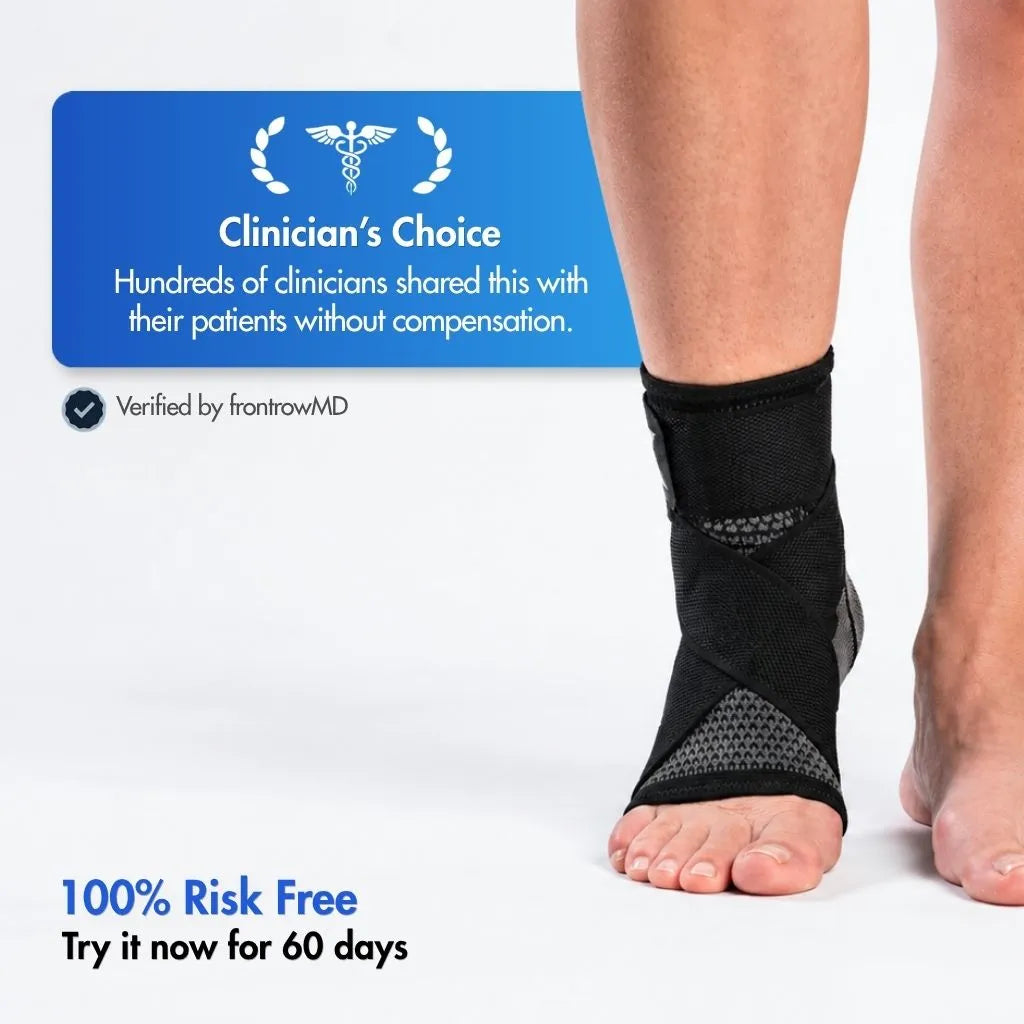
The polyaxial support straps are positioned around the Achilles to directly take the load off the tendon that would normally go straight through it every time your foot hits the ground.
Think of it like adding external scaffolding to the tendon while you move.
You're still walking. You're still getting your steps in. But the Achilles isn't taking the full force of every step by itself.
That Horrible First Step Can Start Feeling Different
That seized-up feeling on your first step out of bed isn't just soreness.
It's your body's failed repair attempt from overnight.
Your immune system sent signals to rebuild, but because the tendon's blood supply is so compromised, the repair materials couldn't actually get there.
So you wake up with the same disorganized, brittle fibers, plus overnight fluid buildup, and that first step feels like the tendon might snap off the back of your heel.
Most people using Comprez notice this starting to change within the first few days.
Not because anything is being masked.
Because when the tearing stops and blood starts reaching the tissue again, the body does exactly what it was always designed to do. It heals.
You wake up. You step down. And it's not what it was.

Reason #5
Get Through A Run Without Thinking About Your Achilles Every Five Minutes
The mental part of this sucks too.
Every run becomes a little negotiation.
How does it feel today? Can it make it three miles? Four? Should the pace come down? Should the run get cut short?
And then there's that moment when the familiar pain starts creeping in and you start wondering whether you should turn around.
That's not really running anymore. It's managing your Achilles while trying to run.
The goal is to get to the point where your Achilles isn't the thing dictating the entire run.
Not constantly checking it. Not waiting for mile 4 when it usually starts screaming. Not finishing a run and immediately wondering how bad tomorrow morning is going to be.
Just running.
Get Back To Moving Like You Used To
Chronic Achilles pain has a way of shrinking your life little by little.
First you stop running.
Then you stop going on long walks.
Then you skip the gym. You stop doing squats. You take the elevator instead of the stairs. You start thinking twice before doing anything that means being on your feet for a while.
Eventually, you realize you're making decisions around your Achilles without even thinking about it.
And honestly, that's probably the worst part.
It's not just the pain. It's slowly giving up the things you used to do without a second thought.
The goal isn't to spend the rest of your life resting your feet.
It's to get back to moving normally again.
Walking. Working out. Hiking. Taking the stairs. Doing the things you actually want to do without wondering what your Achilles is going to feel like afterward.

Reason #7 (Bonus)
60-Day Money Back Guarantee
If you wear the Comprez sleeve consistently and don't notice a real difference in how your Achilles feels, you don't have to keep it.
You've got 60 days to actually try it and see how your mornings, walks, and runs feel.
If it doesn't help, send it back and get your money back.
That's the promise, and there's no long list of conditions or hoops to jump through.


Comprez™ - AchillesRecovery Sleeve
Comprez™ Achilles Recovery Sleeve is a first-of-its-kind compression sleeve designed to reverse tendon degeneration, stop the breakdown cycle, and get you moving pain-free, without surgery or injections.
It is designed to be worn throughout your normal day and works continuously while you move, so recovery happens during your real life - not instead of it.
 Stops Achilles Tendon Breakdown At The Source
Drives Fresh Blood Into Starved, Degenerating Tissue
Relieves That Stabbing First Step Out Of Bed
Recovery Happens While You Move, Not Instead Of It
BUNDLE & SAVE

Couldn't load pickup availability
 60-Day Money Back Guarantee

"I'm a nurse and on my feet for 12 hours a day. My Achilles got so bad I was limping to my car after every shift. Tried compression socks, orthotics, stretching, nothing helped. After about a week with the Comprez™ sleeves, I could get through a full shift without that awful pain. I've worn it every day since and I don't even think about my achilles anymore."



60-Day Money Back Guarantee
If your Achilles doesn't feel better, you don't pay. Simple as that.

Free Shipping
We provide fast shipping on all orders. Enjoy free shipping on orders over $50.

BUILT TO BE WORN EVERY DAY
Medical-grade compression that holds its shape wash after wash. No bunching, slipping, or lost elasticity.
The Comprez™ Sleeve
Is The Smarter Way To Treat Achilles Pain
It's drug-free, works fast, and actually works with your body, not against it.
Real Users
Real Life-Changing Results

Back To Full Shifts After 18 Months of Suffering
Ok, so I've had achilles problems for like a year and a half. Tried the boot, pt, pretty much everything. My coworker told me about this so i figured why not. Been wearing it for 2 weeks and my mornings are completely different. I actually just walk to the kitchen now without hobbling. Wish I got those sooner.

Didn't Expect It to Work THIS Well!
I was honestly close to booking surgery. Spent around $800 on orthotics and pt and nothing helped. Then I saw this on facebook and figured it probably wouldn't work either. But after the first day, I did a full grocery run without stopping once. That hasn't happened in months.

My Son Kept Telling Me To Try It
My son bought this for me after watching me limp around for months. I didn't expect much because these looked just like regular compression socks. But after wearing it for a few hours, that tight pulling feeling was already better. By the end of the week I was walking the dog again
3 Simple Steps To Relieve
Achilles Pain

Slide the Comprez™ sleeve over your foot and position the support straps along the back of your ankle. Thirty seconds.

Stand up. Bilateral compression kicks in immediately. Support straps take the load off the damaged tendon the moment you're on your feet.

Go about your day. Wear it through your shift, your errands, your walk. Recovery happens while you move.

Special Offer On Now!
Try the Comprez™ sleeve risk-free at our lowest price ever. Order today and you'll get:
Stops Achilles Tendon Breakdown At The Source
Drives Fresh Blood Into Starved, Degenerating Tissue
Relieves That Stabbing First Step Out Of Bed
Works All Day While You Move, No Downtime Required

100% Satisfaction 60-Day
Money Back Guarantee
If your Achilles doesn't feel meaningfully better, you don't pay. That's the whole deal.
Try the Comprez™ sleeve for 60 days. Wear it daily. If you don't notice real, lasting improvement in how your tendon feels - mornings, long days, all of it - reach out and we'll refund every cent. No forms, no runaround, no questions asked.
We offer 24/7 email support. Contact us anytime.
Support@comprez.store
Frequently Asked Questions
We want you to know exactly what to expect. That's why we've answered the most common questions here.
Collapsible content
Will the Comprez™ Achilles Recovery Sleeve actually relieve my pain?
Will the Comprez™ Achilles Recovery Sleeve actually relieve my pain?
If your pain has lasted longer than 4-6 weeks, you're dealing with tendinosis - not inflammation. The Comprez™ sleeve is specifically designed to target that. Most users notice a real difference within the first few days of consistent wear.
How quickly will I notice results?
How quickly will I notice results?
Many users feel support and relief the first day. Meaningful, lasting improvement typically starts within the first week. Full recovery varies depending on how long the degeneration has been building, but most users report significant changes within 30 days.
How long should I wear it each day?
How long should I wear it each day?
As long as possible. The more consistently you wear it, the faster the tendon rebuilds. Most users wear it throughout their entire day and remove it before bed.
Can I wear it inside my regular shoes?
Can I wear it inside my regular shoes?
Yes. The sleeve is slim enough to fit inside sneakers, work boots, and most everyday footwear without any bulk or discomfort.
What sizes does it come in?
What sizes does it come in?
The Comprez™ sleeve comes in M, L, and XL. Refer to our size guide to find your fit before ordering.
What is your return policy?
What is your return policy?
60 days, no questions asked. If you don't feel a real difference, email us at support@comprez.store and we'll refund every cent.